
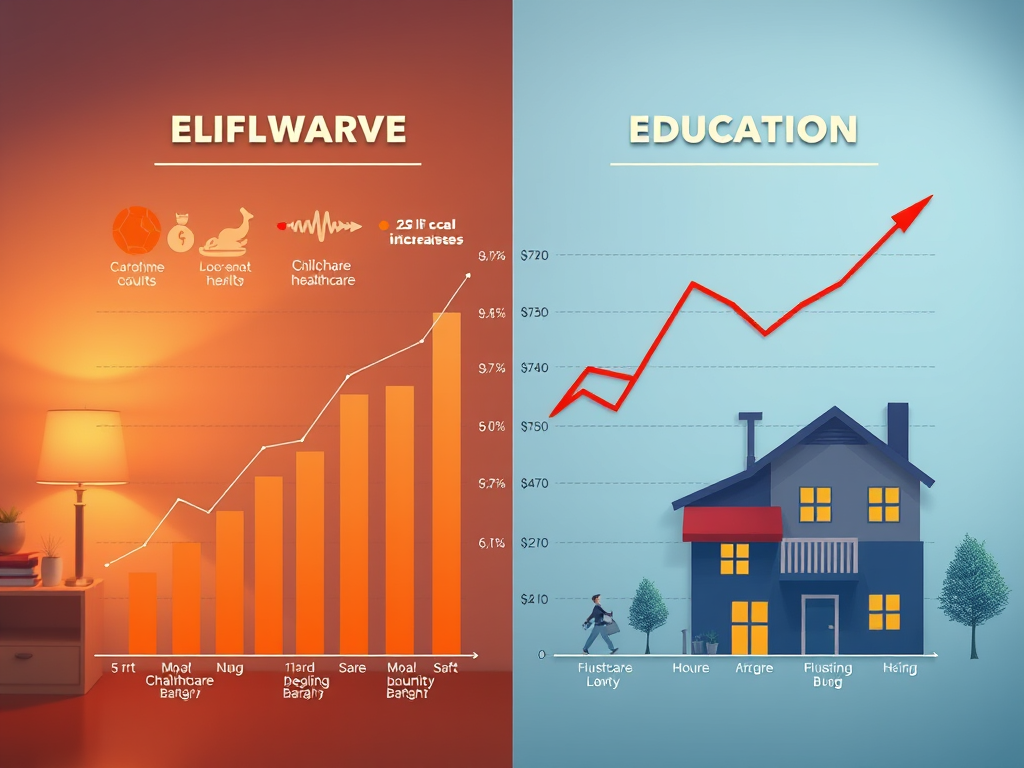
Inflation isn’t what you read in the CPI report. The real cost of living — childcare, healthcare, education, and housing — has outpaced official inflation by 2–3x for decades. Understanding your personal inflation rate is critical for financial planning.
Here’s a data-driven breakdown of where costs have truly exploded, and what you can do about it.
Official Inflation vs. Real-World Costs
| Category | CPI Inflation (20yr avg) | Real-World Cost Increase |
|---|---|---|
| Overall CPI | 2.5%/year | N/A (benchmark) |
| College tuition | 3.5%/year | 5–7% at many schools |
| Healthcare | 3.8%/year | 5–8% for actual premiums |
| Childcare | 4.2%/year | 5–8% in major cities |
| Housing (rent) | 3.2%/year | 6–10% in hot markets |
| Groceries | 2.8%/year | 3–5% post-2020 |
| Electronics | -2%/year | Prices falling consistently |
If your major expenses are childcare, healthcare, and housing, your personal inflation rate is 5–7% — double the official CPI. This means your investments need to earn more just to keep up.
How to Calculate Your Personal Inflation Rate
- List your top 5 expense categories and their monthly costs
- Look up what you paid for each category 3 years ago
- Calculate the percentage increase for each
- Weight by proportion of your total spending
Use Richify’s Reality Check tool to compare cost of living across cities and see how your personal living costs stack up against national averages.
The Shrinkflation Effect
Companies raise prices invisibly by reducing product size while keeping the price the same. That “same” $4.99 bag of chips now has 20% fewer chips. That $6.99 ice cream container shrank from 64oz to 48oz. Your dollar buys less even when prices don’t appear to change.
Geographic Cost Differences
| City | Cost Index (NYC=100) | $100K Salary Equivalent |
|---|---|---|
| New York City | 100 | $100,000 |
| San Francisco | 95 | $95,000 |
| Austin, TX | 65 | $65,000 |
| Nashville, TN | 60 | $60,000 |
| Des Moines, IA | 48 | $48,000 |
Earning $100K in NYC and $65K in Austin provides the same purchasing power. Geographic arbitrage — earning a high salary in a low-cost area — is one of the most powerful wealth-building strategies available.
Strategies to Combat Rising Costs
- Grow your income faster than inflation: Negotiate raises, switch jobs, build skills
- Geographic arbitrage: Remote work from a lower-cost city
- Lock in costs: Fixed-rate mortgage, long-term insurance policies
- Invest aggressively: Your portfolio must beat your personal inflation rate
- Reduce big three costs: Housing, transportation, and food are 60–70% of most budgets. Optimize these first.
- Track actual spending: Know exactly what you spend to calculate real inflation impact
Frequently Asked Questions
Why doesn’t CPI match my experience?
CPI tracks a broad basket of goods weighted by the “average” consumer. Your personal spending pattern likely differs significantly. CPI also uses methods that can understate housing costs (owner’s equivalent rent vs. actual mortgage payments).
Is relocation worth it to save money?
If you can maintain the same income (remote work), relocating from a high-cost to mid-cost city can save $20,000–$40,000/year. That’s $200K+ over a decade, invested. But factor in social connections, career opportunities, and quality of life.
🚀 Take Control of Your Finances with Richify
Understand your true cost of living. Use the Reality Check tool to compare costs across cities, then calculate the opportunity cost of staying in a high-cost area vs. relocating.
📱 Download the Richify app to track your spending and understand your personal inflation rate.
Disclaimer: This article is for educational purposes only. Cost data is approximate and varies by specific location.




Leave a Reply