
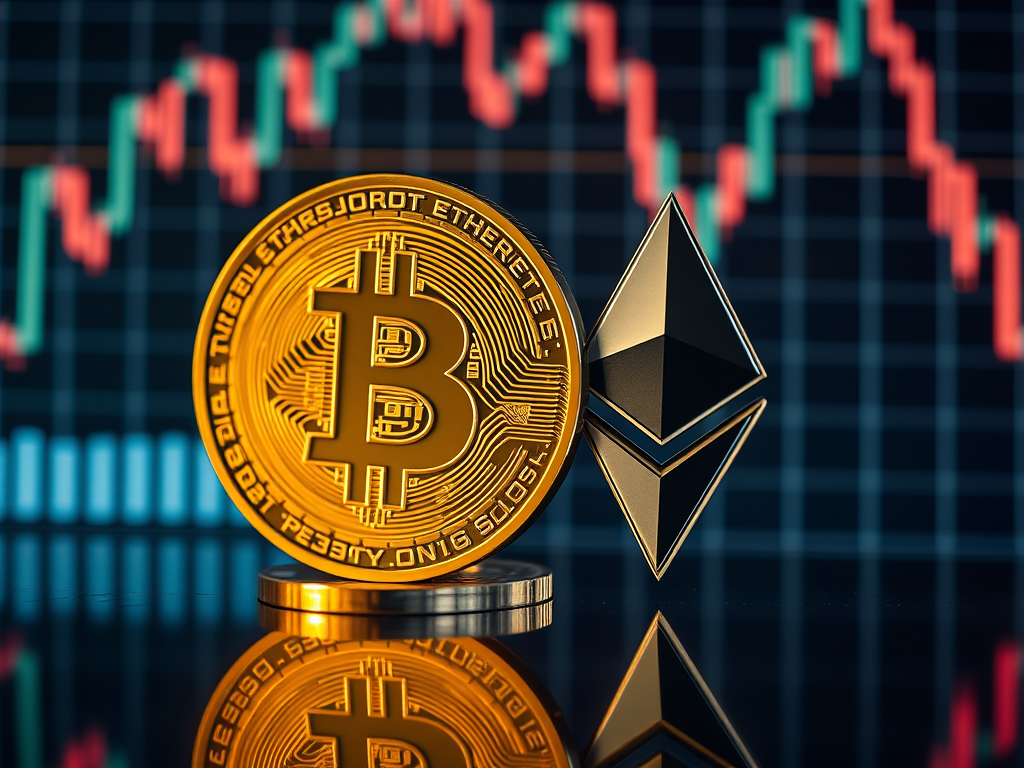
Bitcoin ETFs now hold over $100 billion in assets. Ethereum ETFs have launched. Crypto has gone from a niche curiosity to a legitimate asset class traded on the NYSE. But should YOU own Bitcoin, Ethereum, or other cryptocurrencies? And if so, how much?
Bitcoin vs. Ethereum: The Fundamentals
| Feature | Bitcoin (BTC) | Ethereum (ETH) |
|---|---|---|
| Purpose | Digital gold / store of value | Programmable money / smart contracts |
| Supply | Fixed: 21 million (forever) | Dynamic (~120M, slight deflation post-merge) |
| Market cap | ~$1.5 trillion | ~$400 billion |
| Consensus | Proof of Work | Proof of Stake |
| Yield | None (unless lent) | 3.5–4.5% staking yield |
| ETF available | Yes (IBIT, FBTC, ARKB) | Yes (ETHA, FETH) |
| Use case | Inflation hedge, censorship-resistant money | DeFi, NFTs, tokenization, dApps |
How Much Crypto Should You Own?
| Investor Profile | Crypto Allocation | Composition |
|---|---|---|
| Conservative | 0–2% | BTC only (via ETF) |
| Moderate | 2–5% | 70% BTC, 30% ETH |
| Aggressive | 5–10% | 60% BTC, 30% ETH, 10% others |
| Crypto-native | 10–20% | Diversified crypto portfolio |
Key rule: Never invest more in crypto than you can afford to lose entirely. A 50–80% drawdown should NOT impact your overall financial plan.
The Case for Bitcoin
- Fixed supply: Only 21 million will ever exist. Every other asset can be printed or created.
- Institutional adoption: BlackRock, Fidelity, and major banks now offer Bitcoin products
- Inflation hedge: Bitcoin has outperformed gold over every 4+ year period in its existence
- Halving cycles: Supply reduction every 4 years has historically preceded major bull runs
- Network effect: 200+ million users globally. Growing adoption in countries with unstable currencies.
The Case for Ethereum
- Smart contract platform: Powers 80%+ of all DeFi, NFTs, and tokenization
- Staking yield: Earn 3.5–4.5% annually just for holding and staking
- Deflationary: Since the Merge, ETH has been burning more tokens than it creates
- Real-world asset tokenization: Bonds, real estate, and securities moving on-chain through Ethereum
How to Buy: ETFs vs. Direct
| Method | Pros | Cons |
|---|---|---|
| ETF (IBIT, FBTC) | Simple, held in brokerage, familiar | 0.25% fee/year, no self-custody |
| Coinbase/Kraken | Full feature, on-ramp easy | Higher fees, exchange risk |
| Self-custody (Ledger) | Maximum security, your keys | Complexity, losing keys = losing funds |
For most investors, a Bitcoin ETF in your brokerage account is the simplest and safest entry point. No wallets, no seed phrases, no exchange accounts.
Crypto Risks
- Extreme volatility: 50–80% drawdowns are normal and expected
- Regulatory risk: Governments may increase restrictions
- Technology risk: Competing chains, protocol vulnerabilities
- Psychological risk: Can you hold through a 60% drawdown without panic selling?
Frequently Asked Questions
Is it too late to buy Bitcoin?
People have asked this at every price point since $1. If Bitcoin reaches its potential as digital gold ($500K+ per coin), current prices are still early. If it fails and goes to zero, then yes, it’s too late. Position sizing handles this uncertainty: a 5% allocation means even a complete loss is survivable.
🚀 Take Control of Your Finances with Richify
Track your crypto alongside stocks, bonds, and real estate. Use Richify’s Portfolio View for a unified dashboard across every asset class.
📱 Download the Richify app to manage your complete financial portfolio including cryptocurrency.
Disclaimer: Cryptocurrency is extremely volatile. Never invest more than you can afford to lose. This is not financial advice.




Leave a Reply